

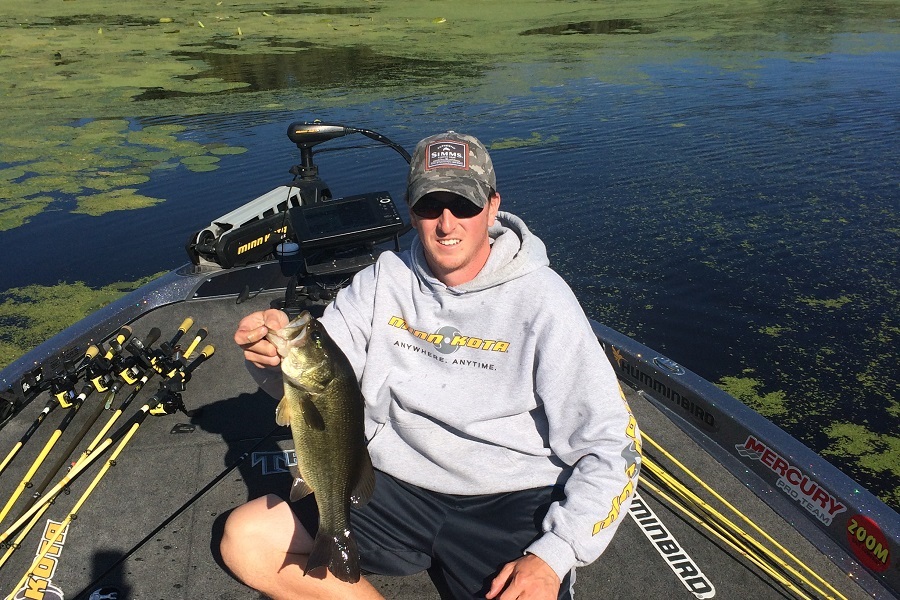
When looking at a lily pad field or a dense mat of hydrilla or milfoil, one may think that there is only one way to skin a cat (or one way to target the bass holding in that vegetation). The fact of the matter is that the location of the bass in relation to the mat alters the presentation and the gear used to catch that bass.
There are two ways the bass relate to the vegetation. It can be buried underneath the mat or it can be on the edge.
At times, the thickest and nastiest mats on a body of water will hold some of the biggest bass on a lake. This is because these mats provide the bass with overhead protection from the sun’s heat and predatory birds, along with providing them numerous ambush spots to set up in. These ambush spots allow a bass to pick off an easy meal, as these mats are normally loaded with plenty of food for a bass to key in on.
 BURRIED BASS
When fishing these dense blankets of vegetation, you’ll want to employ these tactics to properly target these buried bass.
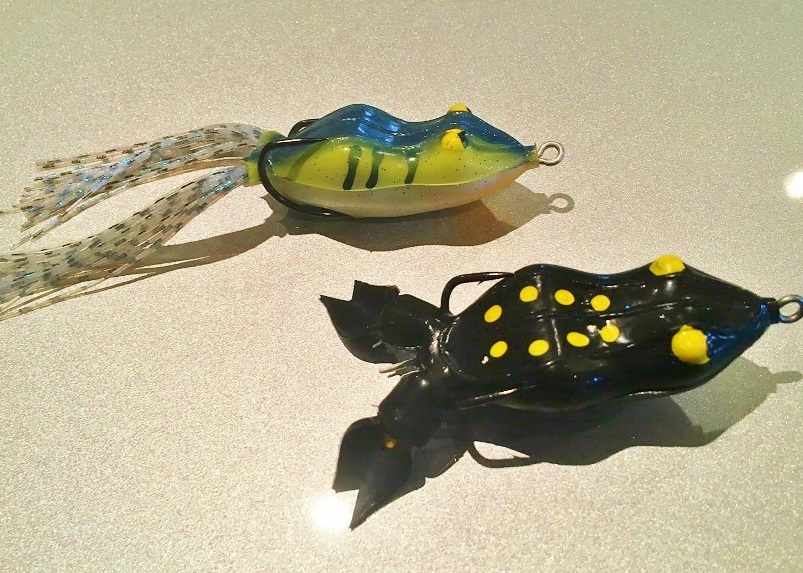
The first and most effective way to fish these mats is to use a hollow-bodied topwater frog, as these baits are nearly impossible to snag and bass will be looking to feed upwards when buried in these mats.
Since these mats may be very dense, you’ll want to use a frog that has a large profile as this will help displace the matted vegetation as you work it across the top of it. I’ll start with a Snag Proof Bobby’s Perfect Frog as I cover water quickly by walking-the-dog across the top of the mat.
Once I have identified a key area in that mat that has a concentration of bass I switch it up to the Guntersville Frog. I’ll do this because it has dual rattles in its legs, which will help entice a mat buried bass into biting, especially when I’ll let that frog sit idle in a hole or near a key weed clump and then just shake my rod to make those rattles make noise.
The other tactic that can be used to target bass that are buried in these dense mats is punching a jig or Texas-rigged soft plastic through the mat and down to where the bass are hiding.
The key here is to make sure you are using a heavy enough tungsten weight, as you need to get your bait through that dense mat of vegetation and down to where the bass is, if you use too small of weight, your bait will get hung up on the way down and not be in the right position to entice a strike. Common weight sizes for punching range from ¾- to 1 ½-oz.
A compact soft plastic with few appendages is a wise choice as it will slide through the web of vegetation without getting hung up. I like to use a Zoom Speed Craw or the new Z-Craw Jr rigged on a Lazer TroKar 4/0 TK130 Flippin hook.
My mat fishing gear includes:
Rod – Wright & McGill Victory Pro Carbon Jig/Big Worm Rod (7’4” Heavy action that drives the hook home)
Reel – Wright & McGill Victory Pro Carbon high-speed (allows me to pick up the slack quickly)
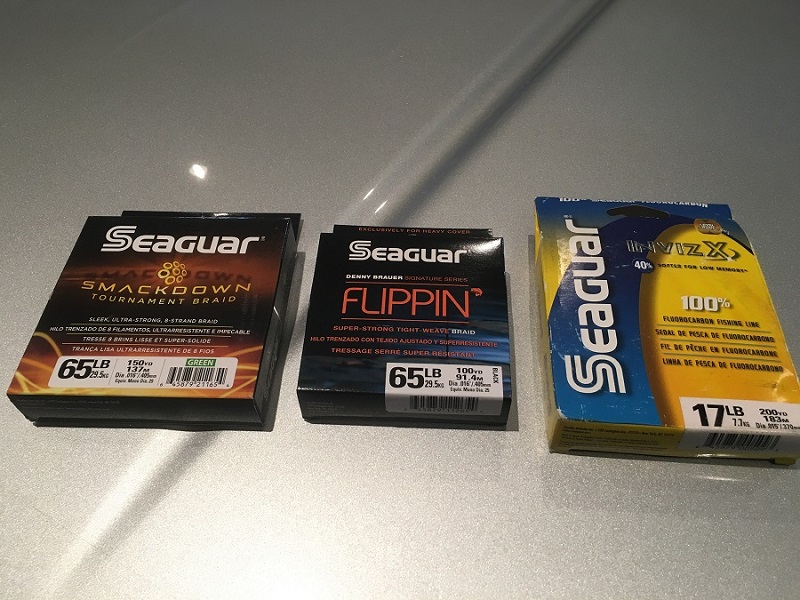
Line –65 lb test Seaguar Smackdown braided line when fishing a frog and Seaguar Flippin’ Braid when punchin’ (both cut through the vegetation and has no stretch)
 ON THE EDGE
The reason that some bass will set up on the edge of the vegetation, in lieu of burring themselves in the middle of the mat, is that there may be a current source running along the edge of that vegetation. This current is key to bringing fresh, oxygenated water into that vegetation, along with forage for the bass to eat as it is pushed by that weed line.
Bass will also position themselves on the edge early in the morning or in the evening when the sun isn’t high in the sky and baitfish/bluegills are moving along that edge, meaning an easy meal for a bass.
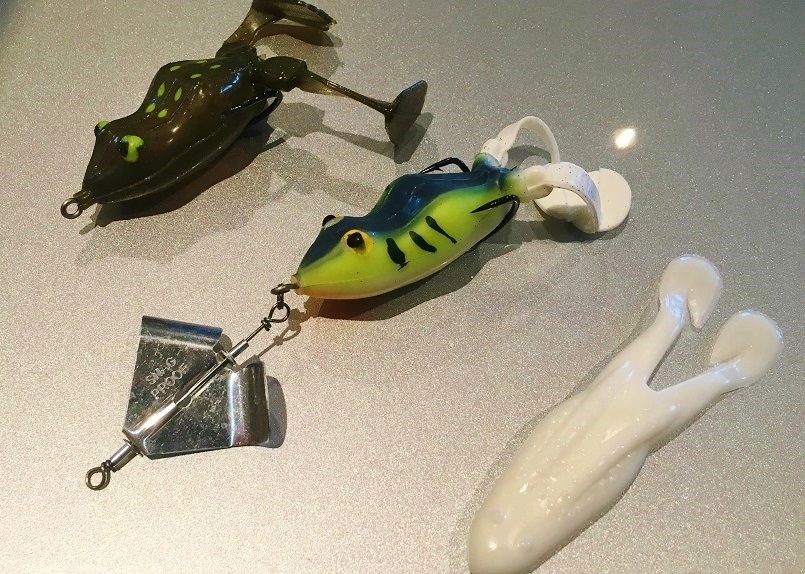
Fishing a hollow-bodied frog here is still a viable option. as you are still making casts just past the edge onto the matted vegetation or making a long parallel cast along the matted edge. I’ll switch my frog selection up to a Snag Proof Wobbletron, as its kicking legs produce a very nice action in that open water or sparse vegetation.
When the vegetation is vary sparse or I’m making a parallel cast to the vegetation, I’ll fish a Snag Proof Perfect Buzz Frog, as it still has a weedless body, but with a buzzbait blade in front of it fishes like a buzzbait. Here, I’ll also use a soft plastic frog, like the Zoom Horney Toad rigged on a 4/0 Lazer TroKar Magnum EWG hook.
The above presentations work well to cover a vast amount of water quickly to locate the right forms of cover or an active school of bass.
If I need to slow down, I’ll use a soft plastic stickbait rigged weedless, such as the Zoom Fluke Stick or Magnum Trick Worm, rigged on a 5/0 Lazer TroKar Magnum EWG hook. I make a long cast along the edge and let my bait slowly sink down; this finesse presentation is a great way to target these bass on the edge.
When I’m fishing the edge, I’ll use the following gear:
Rod – Wright & McGill Tessera Series Frog Rod (7’2” Heavy action that drives the hook home and soft tip to impart more action into my frog) or a Wright & McGill Victory Pro Carbon Jig/Big Worm 7’4” Rod for my soft plastics
Reel – Wright & McGill Victory Pro Carbon high-speed (allows me to pick up the slack quickly)
Line – Seaguar Smackdown 65 lb test braided line frog topwater frogs (cuts through the vegetation and has no stretch) and 17 lb Seaguar Inviz Fluorocarbon for soft plastic stickbaits
 As you are on the water this summer and looking at a field of vegetation, be sure to identify where the bass have positioned themselves, are they buried underneath the mat or are they out on the edge? It may be possible that they are roaming and feeding on the edge during the low-light hours and then as the sun gets overhead they head underneath the mat. Whatever the case may be, be prepared to alter your tactics and gear to be able to target those bass in the most effective way possible.
For more information check out glennwalkerfishing.com or on Facebook at facebook.com/glennwalkerfishing.
 Advertising